Usage
CLI
python -m zdem_dfn --input DIR --output DIR [--seed SEED]
                   [--dry-run] [--verbose] [--stats PATH] [--rose PATH]

# compatibility batch interface:
python -m zdem_dfn [--dirs DIR [DIR ...]] [--out PATH] [--seed SEED]
                   [--suffix STR] [--in-place] [--dry-run] [--stats PATH] [--rose PATH] [--version]
Output is non-destructive by default: tagged particles are written to
<stem><suffix><ext> next to the source file (default suffix _dfn →
ini_xyr_dfn.dat); the source ini_xyr.dat is never modified unless
--in-place is passed. An empty --suffix is refused without --in-place
because it would silently overwrite the source.
| Flag | Meaning |
|---|---|
--input DIR |
Recommended single-case input folder containing ini_xyr.dat; use with --output |
--output DIR |
Recommended output folder; created automatically and receives all artifacts |
--dirs DIR [DIR …] |
Compatibility batch interface for one or more folders |
--out PATH |
Compatibility preview image output path |
--seed N |
RNG seed — same seed, same network |
--suffix STR |
Output filename suffix (default _dfn → ini_xyr_dfn.dat); empty string requires --in-place |
--in-place |
Overwrite the source file (legacy behavior; off by default) |
--dry-run |
Validate and print the plan; write no files or images |
--stats PATH |
Write a network statistics report (.csv → CSV, otherwise Markdown); skipped during --dry-run |
--rose PATH |
Write a polar rose diagram (PNG) of fracture strike; skipped during --dry-run |
--version |
Print the version and exit |
Exit codes: 0 success, 1 configuration error (no directories / missing
reference file / no valid particles), 2 invalid argument combination (empty
--suffix without --in-place).
Input and output format
See Data format for the supported ini_xyr.dat records,
units, directory layout, output files and synthetic-demo disclaimer.
Fracture-set configuration
Each entry in zdem_dfn/config.FRACTURE_SETS defines one orientation family:
{
    "set_name": "Secondary_Joints",  # family name
    "p21": 0.001,                    # trace intensity: m of trace per m² of area
    "length_mult": 3.0,              # mean length = average particle diameter × mult
    "length_std_ratio": 0.3,         # log-normal spread (σ/μ)
    "dip_mean": -45.0,               # dip in degrees (sign sets the sense)
    "dip_std": 5.0,
    "truncation_prob": 0.90,         # chance of being truncated by a longer set
}
Longer sets truncate shorter ones (T-intersections). Add, remove or reweight entries to compose conjugate patterns.
Examples
Parameter gallery
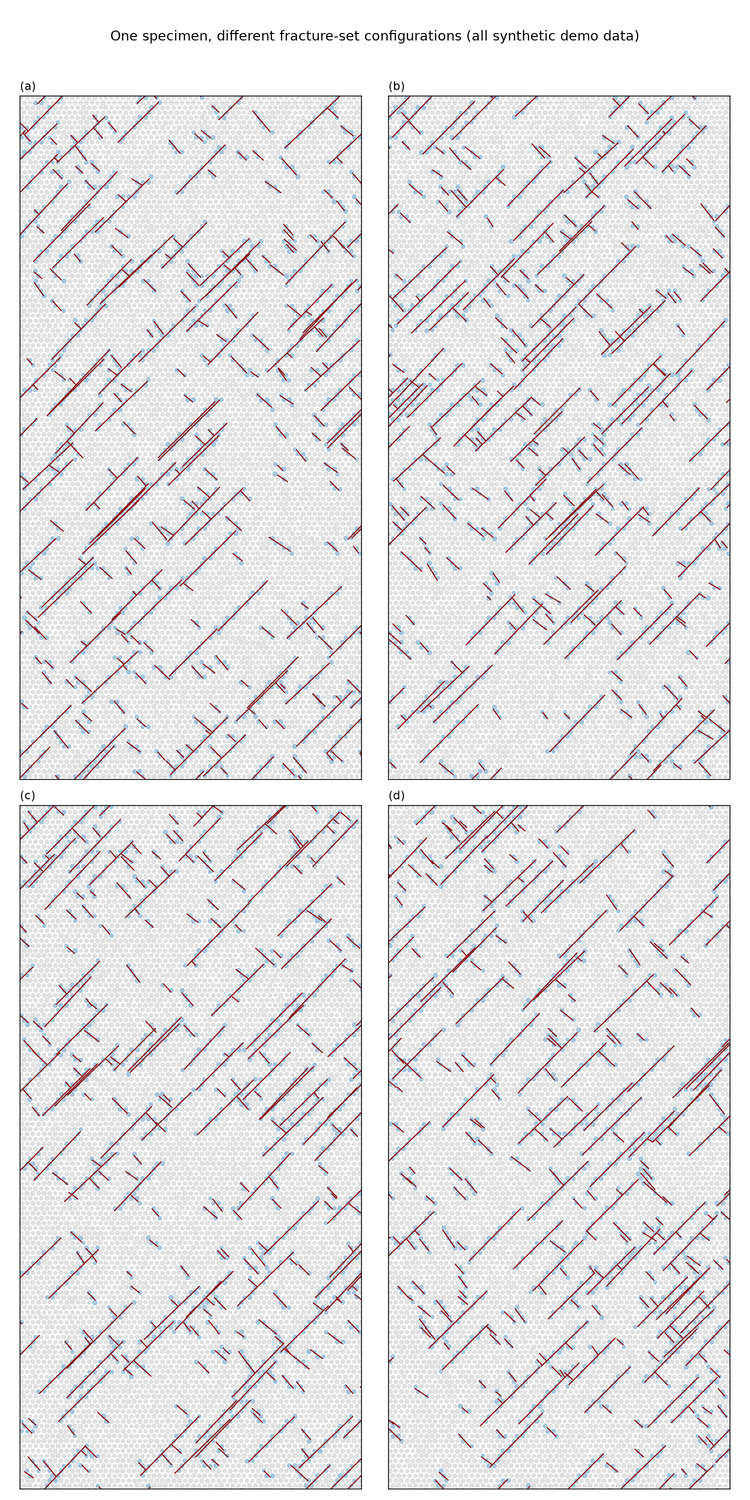
python examples/gallery.py --out docs/screenshots/dfn_gallery.png
Renders the same synthetic specimen under four fracture-set configurations (default, single steep set, dense web, sparse corridor faults):
Hash-grid vs brute-force benchmark
python examples/benchmark_sampling.py
Hash-grid tagging beats the O(P×F) brute-force search (~11× at 10 000 particles × 400 segments) with tested tag equivalence.
Programmatic use
import random
import zdem_dfn.config as config
from zdem_dfn.main import run_batch

config.TARGET_DIRECTORIES = ["path/to/specimen"]  # runtime override
random.seed(42)
run_batch()
Note
Read config values through the module (config.CROP_MIN_X), never
from config import CROP_MIN_X, so runtime overrides keep working.